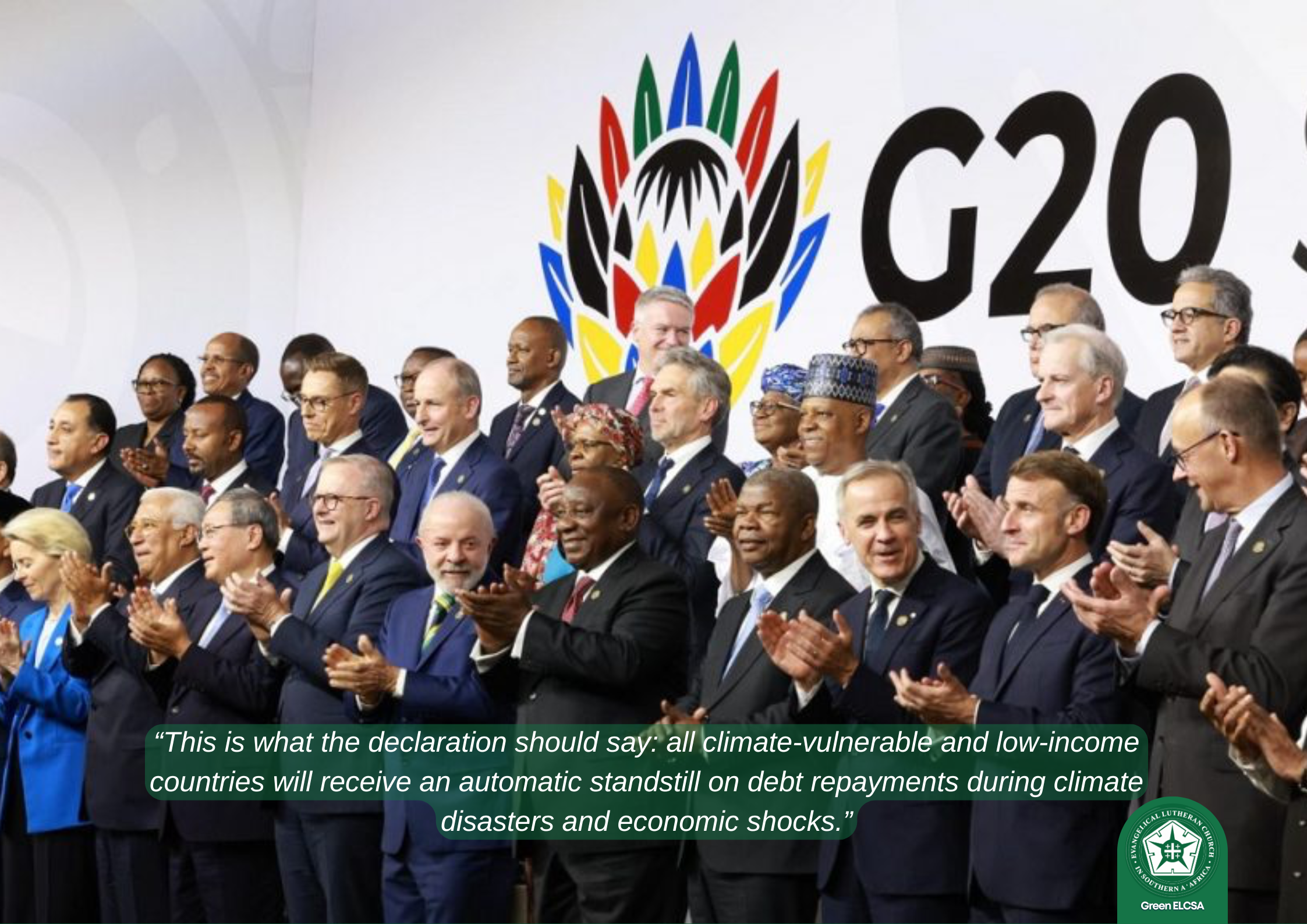

“We reiterate our commitment to further strengthen the implementation of the G20 Common Framework (CF) for debt treatments beyond the Debt Service Suspension Initiative (DSSI) in a predictable, timely, orderly, and coordinated manner.”
This single sentence from the 2025 G20 Leaders’ Declaration captures the entire challenge of our moment. While leaders acknowledge debt distress, they remain committed to frameworks that have proven slow, limited, and deeply inadequate for countries in crisis. This is what the declaration should say: all climate-vulnerable and low-income countries will receive an automatic standstill on debt repayments during climate disasters and economic shocks. That means, pause all debt payments immediately when a country is hit by a cyclone, flood, drought, conflict, or pandemic, and free up fiscal space for emergency response, not creditor repayment. Because no government should be forced to choose between saving lives and paying creditors, that is the moral heart of Jubilee.
Established in 1999, the G20 brings together 19 countries and the European Union as a forum to address major international economic and financial challenges. In 2025, South Africa held the presidency, and at the final stage of its term it hosted the G20 Leaders’ Summit, where the key outcome document of the entire process - the Leaders’ Declaration - is traditionally adopted. This document is important because it represents a unified commitment to multilateral cooperation and outlines a plan of action agreed upon by all members/countries.
From a faith and justice perspective, the most striking gap was the absence of a meaningful response to the Global Jubilee 2025 call: a worldwide movement urging deep debt cancellation, fair restructuring, the removal of harmful conditionalities, and protection of essential social spending. And the declaration mentions or commits nothing in relation to that, which is why I suggest that it signals a commitment to frameworks and not real action.
Jubilee is not only a financial principle; it is a moral one. Scripture teaches us that debts must not become permanent instruments of bondage, and that creation must be restored through cycles of release, renewal, and justice. The G20’s incremental steps on debt sustainability, while welcome, do not rise to the scale of the crisis faced by many African and Global South nations.
Without genuine Jubilee measures, countries continue to divert resources away from health, education, climate resilience, and community development, perpetuating cycles that contradict God’s vision for human dignity.
This global moment also resonates with us in ELCSA as we mark our Golden Jubilee. I think this is a theological invitation to reflect on freedom, repair, and renewal. It calls us to imagine a church and a society where justice is restored, where creation is healed, and where no community is left behind. We should affirm that a true Jubilee is both spiritual and structural. It requires systems that protect life, uplift the poor, and honour God’s creation.
In this Jubilee year, as our church looks toward its next 50 years, we are called to join the global movement for economic justice with renewed conviction. The G20 outcomes remind us that governments alone will not deliver Jubilee, it must also be carried by people of faith, civil society, and communities standing together for change.
May this moment awaken our collective courage. And may ELCSA’s Golden Jubilee be a turning point toward deeper justice, healing, and hope for all creation.